Water Softener Installation & Repair in Hollywood, FL
Water softener installation and repair in Hollywood, FL begins with a hardness reading at your tap and ends with a unit matched to your daily water use. Call (954) 697-4920 for a walk-through and a no-obligation number on a new unit, or for repair when scale returns.
- Free estimate on new installs
- Repair and resin service
- Sized to your household
The Problem
What Hardness Does to a Florida House
Hard water carries dissolved calcium and magnesium. When water heats or evaporates, those minerals form scale, which crusts faucets, clogs aerators and coats heating elements. A heater with a layer of scale works harder and fails sooner.
Hollywood's water comes from limestone in the Biscayne Aquifer. The city softens it with lime and ferric chloride at the plant, and the remaining minerals can still show up as white spots on glass and crusty showerheads.
Know Your Number
How Water Hardness Is Classified
| Range (mg/L as calcium carbonate) | Classification | What you may see |
|---|---|---|
| 0 to 60 | Soft | Little scale |
| 61 to 120 | Moderately hard | Light spotting on glass |
| 121 to 180 | Hard | Scale on fixtures, shorter heater life |
| Above 180 | Very hard | Heavy scale, frequent maintenance |
These are the general guidelines utilities commonly publish. Ask the city for the figure at your address before choosing equipment.
Heater, faucets and glass all crusted?
Call for a free estimate on a softener. Bring the hardness number if you have it.
Choices
Salt-Based Softener or Salt-Free Conditioner
A salt-based softener swaps hardness minerals for sodium or potassium and regenerates with a brine solution. It actually removes the minerals, and it needs salt refills and a drain connection.
A salt-free conditioner changes how the minerals behave so they form less scale. It needs no salt and no drain, but it does not remove the minerals, and results vary with the water and the device.
The right answer depends on your hardness, your goals and any HOA or septic constraints. A plumber should explain the pros and cons before quoting.
Troubleshooting
What to Check When a Softener Stops Working
- Look in the brine tank for salt, and break up any crust or bridge you find.
- Check that the unit has power and the display is on.
- Run a manual regeneration cycle if the manual allows.
- Test the water with a hardness test strip before and after the unit.
- If hardness stays high, call for resin, valve or injector service.
Fit With Other Equipment
Where a Softener Fits in the Plumbing
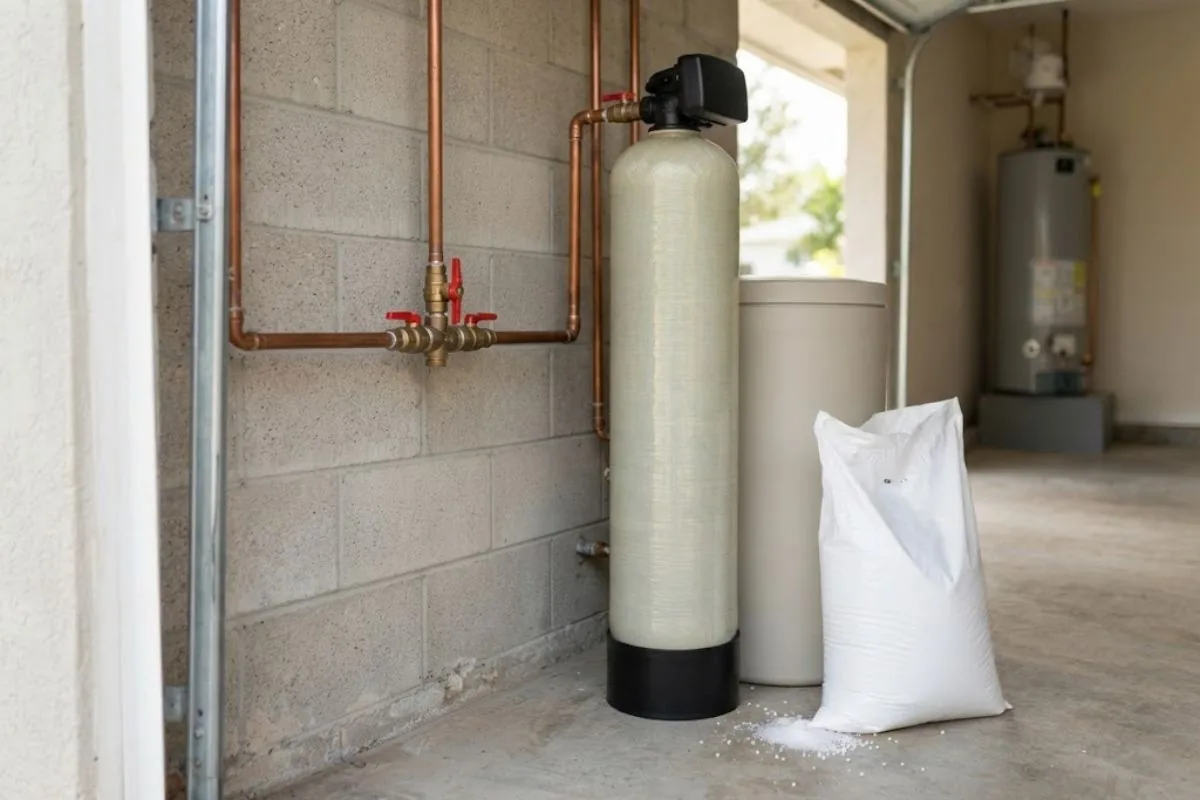
A softener usually goes at the main line after the shutoff, before the water heater, with a bypass so you can isolate it. It needs a drain connection, an air gap on the brine line and a power outlet.
Water that gets softened and then heated lasts longer on heating elements. A softener also protects fixtures and appliances downstream, so owners often add one when installing a new heater or tankless unit. See tankless water heater service and water filtration installation for related equipment.
Local Notes
HOAs, Condos and Septic Homes
Condo owners often cannot add a whole-house softener without board approval, since the main sits in a shared area. Single-family homes in HOAs may need approval for a visible installation.
About 44 percent of Hollywood relies on septic, and regeneration water goes to the tank. Ask for settings that limit salt and water use, and keep the tank on its pumping schedule.
Miramar homes range from older to brand new, and softener sizing differs with the plumbing. Our Miramar page explains how age changes the plan.
Around Hollywood
Hard Water in Hollywood and Where a Softener Fits
Hollywood's water comes from the Biscayne Aquifer, which carries a lot of dissolved minerals. Scale on fixtures and in water heaters is common from the beach to the inland neighborhoods.
A softener suits a house with room near the main line, and it is harder to place in a condo. Bring a hardness reading if you have one.
Pricing
What Shapes the Price of a Softener
New installations get a free estimate. Call (954) 697-4920.
Questions
Water Softener Questions
The city softens its water with lime and ferric chloride at the plant, but treated water can still leave scale. The Water Quality Division at 954.921.3414 can give current hardness figures for your address, and we can test at the tap.
Not always. If you see little scale, a softener may be optional. If fixtures crust over and heaters fail early, a softener or scale control device can help.
Salt-based ion exchange softeners remove hardness minerals. Salt-free conditioners change how scale forms without removing it. Each has trade-offs in performance, maintenance and cost.
It can add brine discharge to the tank, and sizing and regeneration settings matter. Ask the installer how the unit will be set up. For septic care, see household septic tank pumping.
Common causes are empty salt, a salt bridge in the tank, a worn resin bed or a control valve fault. A technician checks salt, brine draw and the resin before recommending parts.
Many HOAs and condos have rules about installation and drain connections. Check with management before you buy.