Low Water Pressure: One Faucet or the Whole House?
If only one faucet has weak water, the usual cause is a clogged aerator or a partly closed shutoff. If every tap is weak, the cause is more likely a partly closed main valve, a failing pressure regulator, a hidden leak or a supply issue outside your house. The pattern tells you where to look.
Match the Pattern to the Cause
| What you notice | Likely cause | First check |
|---|---|---|
| One faucet weak, others fine | Clogged aerator or cartridge | Unscrew and clean the aerator |
| Hot weak, cold fine | Water heater sediment or a partly closed hot valve | Check the heater shutoff and flush the tank |
| Cold weak everywhere | Main valve partly closed, regulator, or service line leak | Check the main valve and the meter |
| Weak only at the highest fixtures | Pressure loss in the house piping | Test at an outside hose bib |
| Sudden drop in a whole street | Utility work or main problem | Ask neighbors, call the utility |
Ten-Minute Diagnosis
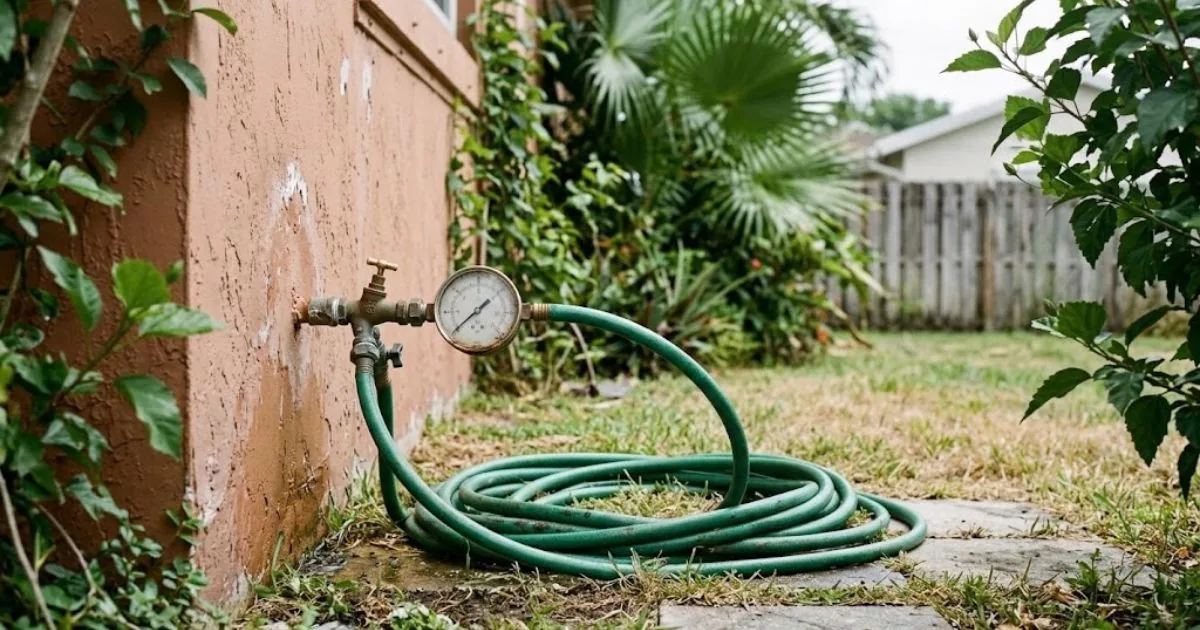
- Test the outside hose bib. Strong flow there means the problem is inside.
- Unscrew the weak faucet's aerator and rinse out mineral grit.
- Make sure the main valve and any fixture valves are fully open.
- Check the water meter with all taps closed. Movement suggests a leak.
- Buy a hose-bib pressure gauge to see actual pressure.
- Compare hot and cold flow at the same faucet.
What Good Pressure Looks Like
Most household pressure sits in the 40 to 60 psi range. The International Plumbing Code (IPC), which the Florida Building Code, Plumbing is built on, sets the maximum static pressure at 80 psi, and many homes use a regulator to keep it below that.
A failing regulator can swing pressure too high or too low. A gauge on a hose bib shows which. If the pressure is high, it can damage fixtures and appliances quickly.
Scale Is the Quiet Culprit in South Florida
Hollywood's water comes from limestone and sand in the Biscayne Aquifer. The city treats it with lime and ferric chloride to reduce hardness and color, but water from limestone can still leave mineral scale on aerators, showerheads and cartridges.
Soaking an aerator or showerhead in vinegar for an hour often restores flow. If it does not, the cartridge or valve inside the fixture may need replacing.
When Pressure Loss Means a Leak
A broken service line between the meter and the house can drop pressure before any water shows. If the meter moves with taps closed and pressure is weak everywhere, leak detection testing is the next step.
A hot-water-only problem usually points to the heater. Sediment can choke flow, and emergency water heater repair covers flushing and part replacement. Miramar has a mix of older and newer homes, and our Miramar page explains what we check by home age.
Pressure Regulators and When They Fail
Many homes have a pressure regulator near the main valve, a bell-shaped brass fitting. It lowers high street pressure to a safe level for the house. Regulators wear out over time, and a failing one can let pressure creep up or cut flow to a trickle.
A gauge on a hose bib is the simplest test. Read it at night when demand is low and again during the day. A big difference, or a reading above 80 psi, points to a regulator problem.
High pressure can cause banging pipes, running toilets and short appliance life, so low pressure is not the only symptom to watch for.
When Only the Hot Side Is Weak
Cold water strong and hot weak is a heater clue. Sediment can choke the outlet at the tank, a partly closed valve above the heater restricts flow and an old galvanized hot line can narrow inside.
Check that the valve on the heater outlet is fully open, then test hot and cold at two fixtures. If both hot taps are weak, the issue is likely at or near the heater.
Low Pressure in a Condo or Apartment
Tall buildings use booster pumps and pressure zones. If every unit on a floor has weak water, tell management. The pump or a zone valve may need attention.
If only your unit is weak, check your unit shutoff, the supply stops and the aerators first. A partly closed valve at the unit entry is a common cause after a repair.
Old Galvanized Pipe
Houses built before copper became common sometimes have galvanized steel supply pipe. It corrodes from the inside, and the buildup narrows the opening until flow drops. Rust-colored water and gradually worsening pressure are the signs.
A repipe replaces the old pipe with copper or PEX. If your house has galvanized lines, weak pressure usually keeps getting worse, and patching one section rarely solves it.
How to Use a Pressure Gauge Correctly
- Screw a hose-bib pressure gauge onto an outdoor spigot.
- Close all taps and turn off the irrigation and icemaker.
- Open the spigot fully and read the static pressure.
- Read it again at a different time of day to catch swings.
- Write both numbers down, because a plumber can use them.
What the Numbers Mean for Your Next Step
A steady 40 to 60 psi with weak fixtures points to a local clog or valve. A reading below 30 suggests a restriction between the street and the house, such as a partly closed valve, a failing regulator or a leak on the service line.
A reading above 80 means the regulator needs attention, even if flow feels fine. High pressure is hard on every appliance and fixture, and leaks follow.
Share the readings when you call. They let the dispatcher plan the right tools before the visit.
When Low Pressure Is Not a Plumbing Problem
Sometimes the cause is outside the house. A utility repair, a nearby hydrant flush or a heavy irrigation draw on the street can lower pressure for a few hours. If pressure returns on its own and neighbors noticed it too, there is nothing to fix on your side.
If it keeps happening at the same time of day, mention the pattern to your utility.
When to Call
Call if the pressure drops suddenly, the meter moves with taps closed, you see wet spots or the problem affects the whole house after you check the main valve. Tell the dispatcher what you tested at the hose bib.
For urgent issues, call (954) 697-4920.
Questions
Quick Answers
It can be. If neighbors have the same problem, contact the utility. If only your house is affected, the cause is likely on your side.
Yes. Old galvanized pipe corrodes inside and restricts flow.
The showerhead or its flow restrictor may be clogged with scale.
Most homes run between 40 and 60 psi. Above 80 is too high under the plumbing code.