How to Find Your Main Water Shutoff Valve in a Florida Home
In most Florida homes the main water shutoff valve is on an exterior wall near the front hose bib, in the garage or utility closet, or in an in-ground box near the street. Find it now, test that it turns and tag it, because you want to know its location before a pipe bursts.
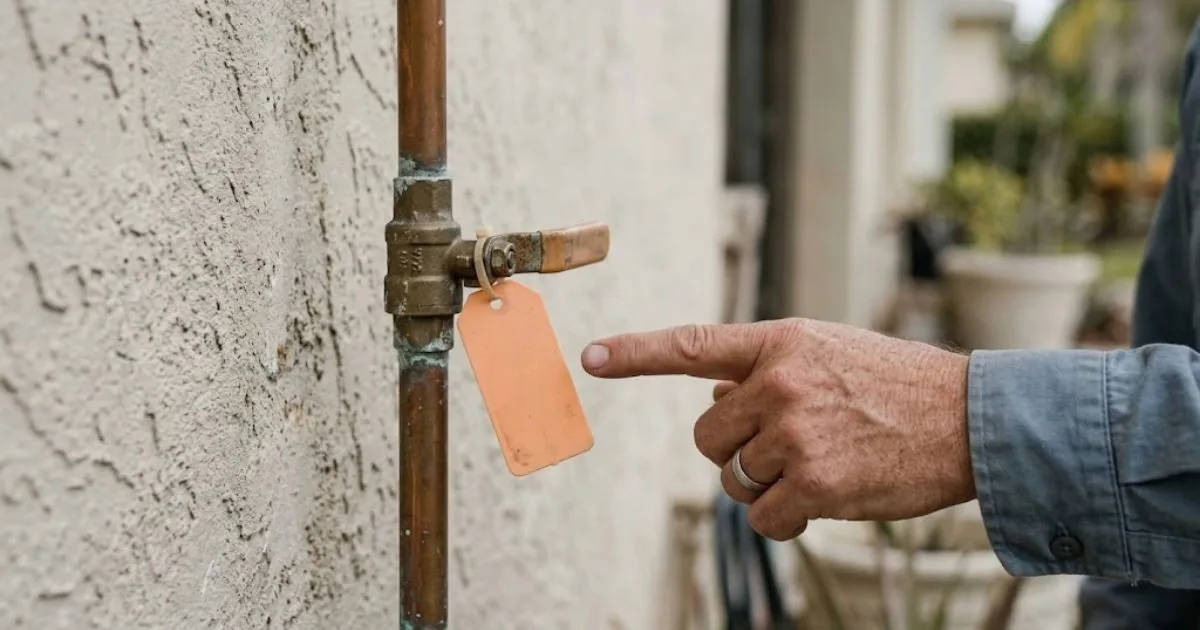
Where to Look, by Home Type
| Home type | Common locations | Tips |
|---|---|---|
| Single-family slab home | Exterior wall near the hose bib, garage wall, utility closet | Follow the supply pipe from the water heater |
| Single-family with a front meter | Valve beside the house after the meter | Do not turn the utility's valve at the meter |
| Condo or apartment | Inside the unit, under a sink, in a closet, near the water heater | Ask management where the unit valve is |
| Mobile home | Near the lot connection or under the skirt | Ask park management for the lot shutoff |
| Older Florida house | Side of the house near a hose bib, or a box in the front yard | Look for a wheel or lever handle |
Two Valves, Two Owners
The utility owns the meter and the shutoff beside it. A homeowner's main valve is on your side, after the meter. If you can reach only the utility's valve, call the utility, not a plumber, to close it in an emergency.
The International Plumbing Code (IPC), which the Florida Building Code, Plumbing follows, calls for full-open valves where the water supply enters a structure and shutoff valves at fixtures, so every house should have one. A homeowner's valve is usually a gate valve with a round wheel or a ball valve with a lever. A lever parallel to the pipe is open, and a lever across the pipe is closed. A wheel closes clockwise.
Test the Valve Once a Year
- Turn the valve slowly to closed and run a faucet to confirm the water stops.
- Turn it fully open again.
- If it is stiff or leaks at the stem, do not force it. Call for service.
- Tag it with a bright label and tell everyone in the house where it is.
- Take a photo for your records.
If the Valve Is Stuck or Missing
Old gate valves often seize, and forcing one can snap the stem. A valve that will not close is a failure waiting to happen, and replacing it is a short job. If the house has no accessible valve at all, installing one at the main is worth doing.
Salt air near the coast corrodes exposed valves quickly, so check yours more often if you live near Hollywood Beach or the Intracoastal.
What to Do When You Find the Leak
Close the main, open the lowest faucet to relieve pressure, and shut off the water heater power. If the meter still moves with the main closed, the leak is outside the house, and electronic leak detection will find it.
If a tank is the source, cut power and close the cold valve, then see water heater repair. Condo owners in Hallandale Beach should also learn the building's riser valve rules, covered on our Hallandale Beach page.
Fixture Shutoffs: The Small Valves That Save Big Messes
Besides the main, every toilet and sink has its own shutoff, called an angle stop or supply stop. They sit on the wall or floor under the fixture. Closing one stops a leak at that fixture without turning off the whole house.
These valves seize if they are never turned. Exercise each one once a year. If one will not close or leaks at the stem when you try, replace it before an emergency.
When the Main Valve Needs Replacing
Gate valves with a wheel handle are common in older houses, and they tend to seize and drip around the stem. Ball valves with a lever are the usual replacement because they shut fully with a quarter turn and rarely stick.
Replacing a main valve means shutting off water at the meter or a point upstream, so call a professional. If you cannot close the main at all, ask the utility to shut the supply while the new valve goes in.
Before You Travel
- Close the main valve if you will be gone more than a few days.
- Turn the water heater to vacation mode or cut its power if the water is off.
- Ask a neighbor or building manager to check the unit.
- Replace old washing machine hoses before you go.
- Leave the plumber's number and your insurance details with someone local.
Teach Everyone in the House
A valve nobody knows about does not help when water is flowing. Show every adult and older child where the main is and how it turns. Put a photo on the fridge or in the family chat, and add a label that is easy to read in the dark.
If you rent, ask the landlord where the main is on move-in day and take a photo.
Run a Five-Minute Family Drill
Pick a calm moment and walk everyone to the valve. Have each person close it, open a tap to confirm the water stops, then reopen the valve. A drill takes five minutes and removes hesitation in an emergency.
Show how to open a low faucet afterward to bleed air, and where the water heater power switch is. If the house has a leak sensor or a smart shutoff, show where its app or button lives.
Repeat the drill when a new person moves in, and after any plumbing work that touches the main.
Do Smart Shutoff Valves Make Sense?
Smart shutoff devices detect unusual flow and close the main automatically. They can help in a vacant home or a condo where a failure could flood the floors below. They need power, a network connection and periodic testing.
They do not replace a manual valve. Keep the manual valve in good shape and treat the smart device as a second layer, installed by a plumber who can set it to your usage.
One Last Habit
Write the valve's location on the inside of a cabinet door and add it to your phone notes. Update the note if you renovate or move the water heater.
A valve you can reach in ten seconds turns a flooded floor into a mop-up. A valve you cannot find turns it into a claim.
What to Do After You Close the Valve
Open the lowest faucet to drain the line, then check that the water heater is off if the main will stay closed for long. Call for help and describe the leak, then photograph the damage before you move anything.
Make the Call Fast
With the water off, call (954) 697-4920 and tell the dispatcher where the water was and that the main is closed.
Questions
Quick Answers
Open a faucet. If water stops and the meter does not move, the valve is closed.
Many people do for a long trip, especially in a condo, but check your insurer's advice.
Close individual fixture shutoffs and call the utility or building management.
Do not. It belongs to the utility. Close your own main instead.